FROZEN
MOMENT
LIVE
ACTION
STOP-
START
SLOW
MOTION
TIME
RAMP
SPACE
RAMP
TIME
BLUR
SPACE
BLUR
LONG
EXPOSURE
MULTIPLE
EXPOSURE
OPEN
FLASH
FLASH
TRAIL
LIGHT
PAINTING
MOTION
DISTORTION
MATCH
CUT
UNIVERSAL
CAPTURE
|
TECHNIQUES - SLOW MOTION
Slow motion (or "Bullet Time" as it was called in the 1999 film The Matrix), like live action, is achieved by internally triggering Digital Air's camera systems sequentially rather than simultaneously (as first described in Dayton Taylor's 1996 American Cinematographer article link).
Because the rate of triggering can be very high all the way up to simultaneous our camera systems can easily record events in super slow motion. For example, using our digital systems we can shoot at any frame rate up to 500,000 frames per second camera-to-camera.
Unlike a motion picture camera the rate of the sequential triggering in our systems can exceed the shutter speed of the camera. This means there is no theoretical limit on how high the frame rate can go (in fact the frame rate can go to infinity - or simultaneity - as it does in the frozen moment).
When using a single high speed camera to shoot slow motion, changes in the frame rate of the camera effect both the motion of the subject and the motion of the camera. With our systems the effect of the high frame rate (across the system) on the speed of the subject is completely independent from the speed of the camera movement. This is because the camera movement is virtual and the speed of the virtual camera movement is dependent only upon the spacing of the cameras.
| |
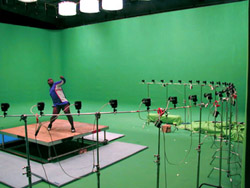
36 camera HD-1 digital system
|
EXAMPLE - SLOW MOTION
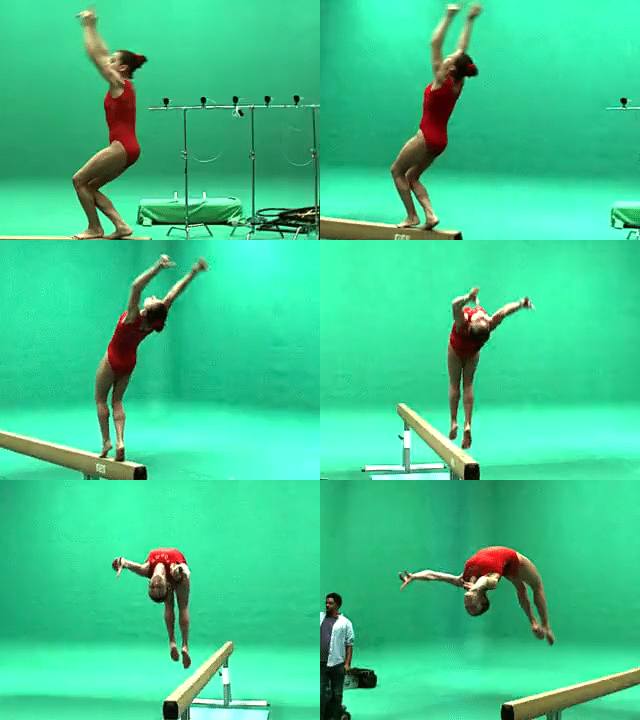
Project: Opening television graphics for the 2004 Summer Olympic Games in Athens
Equipment: 36 camera HD-1 digital system
Client: Athens Olympic Broadcasting
Directors: Daryl Goodrich, Mike Parry, Jan Hallet
Production Company: North One TV (London)
Post Production: Digital Air and Sixfootsix (London)
Producer: Geraldine Geraghty
link to finished spot: https://vfx.digitalair.com/olympics.html
| |
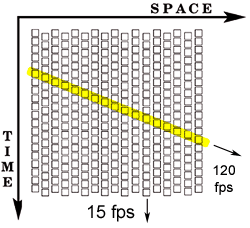
This example of our slow motion effect was recorded by streaming uncompressed frames from every camera in our digital system directly to disk with a time offset. Each camera recorded at just 15 fps, but because of the time offset the effective frame rate when cutting across the image sequence is 120 fps.
|
|
|
